

Equality Is Not Guaranteed
Two hundred fifty years in — and the 28th Amendment is still waiting.

It’s hard to believe we’re just a week away from the unofficial kickoff of summer. This summer is going to hold a lot, too. The ramp-up to the midterms will dominate every news cycle that isn’t already taken by the ramp-up to America’s 250th birthday on the Fourth of July. Two and a half centuries of “freedom,” celebrated against the backdrop of an election that will decide what is left of it.
You would think that equality would be a given by now. Yet here we are.
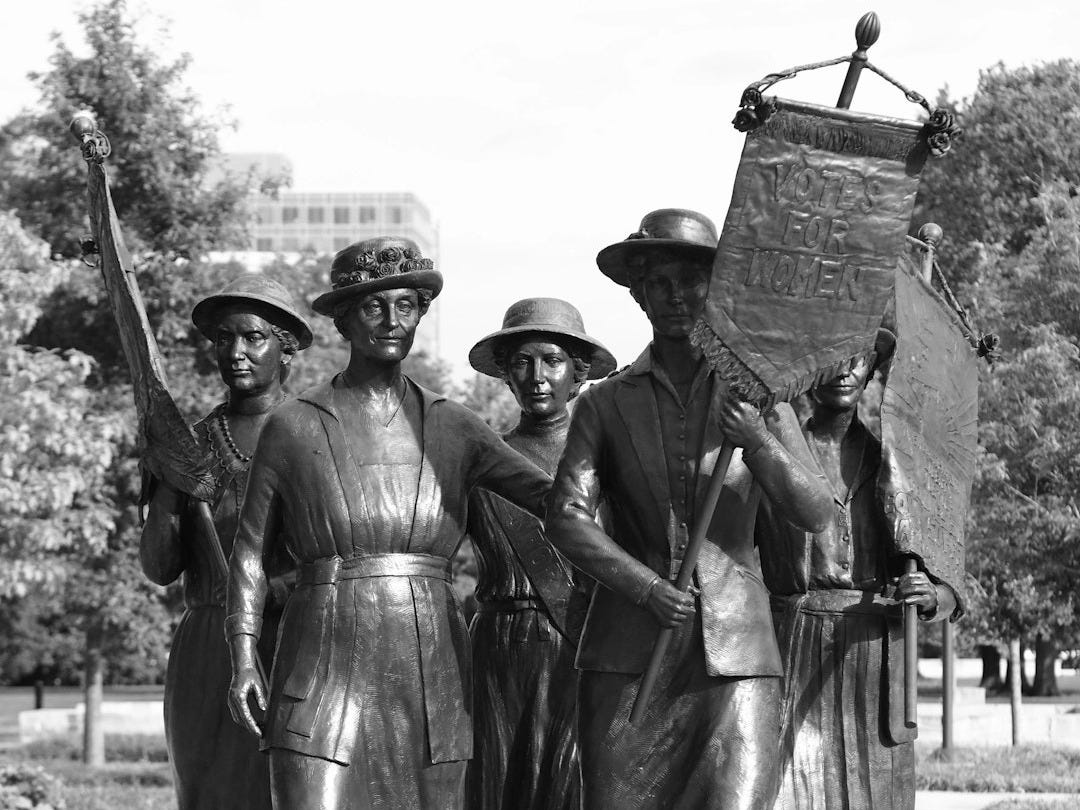
The 14th Amendment promises “equal protection under the law.” That’s the line most Americans assume covers gender equality. But nowhere in the U.S. Constitution is there an explicit prohibition against discrimination based on sex. Everything we have gained on that front — Title IX, the Violence Against Women Act, fair pay laws, reproductive rights — is based on statute, and as we all know, what can be granted through legislation today can be weakened or taken away tomorrow.
The Equal Rights Amendment was supposed protect women and men. Thirty-eight states have ratified it — the three-fourths threshold the Constitution requires – yet the 28th Amendment still hasn’t been officially recognized. At the federal level, in this political climate, something that should have been administrative has become a political war.
But states are not waiting for permission. Earlier this year, Pennsylvania’s courts used the state’s own Equal Rights Amendment — adopted in 1971 — to rule that blocking Medicaid coverage for abortion violated equal rights protections. That ruling did something no federal statute could. That ruling demonstrates the real-world power of constitutional equality protections.
Still, nearly half of U.S. states (21) lack explicit constitutional sex equality protections. Then read this: 21 states have no constitutional sex equality protection of any kind. None. Women in those states are protected by federal statute, or by nothing.
Your rights should not depend on your zip code. Equality should not fluctuate based on which state you live in, which court is hearing a case, or which political party currently holds power.
This is why recognizing the ERA as the 28th Amendment is so important. It is not symbolic. It is foundational.
Equality delayed is still equality denied.
As we approach America’s 250th birthday, can we truly celebrate freedom while constitutional equality for half the population remains unfinished business?
I believe we can do better.
And I believe history will ask whether we had the courage to finish what should have been done long ago.
Do One Small Thing
The fight for the 28th Amendment is bigger than any single one of us, but the actions that close it are not. This week you can:
• Check – Find out whether your state has constitutional equality protections of its own.
• Call – Contact your elected officials and ask where they stand on recognizing the ERA as the 28th Amendment. The asking matters as much as the answer.
• Attend – Consider attending the 2026 NOW Conference at the end of June to connect with others who care about the ERA and gender equality.
• Share – Forward this newsletter to a woman whose rights would be very different if she lived one or two states over.
Three Decades Working for Equal Rights

Publishing the Equal Rights Amendment (ERA) as the law of the land will finally solve every problem women face in the U.S., from being paid less because of their sex to being blamed for being the cause of sexual assault against them. Acts of Congress or policies established elsewhere can be overturned on a whim, and subsequent laws can contradict, mitigate, or eradicate prejudicial treatment of women. In her book, Rumors of Our Progress Have Been Greatly Exaggerated, former Congresswoman Carolyn D. Maloney said, “We need constitutional rights, not legislative fights. As it stands now, what judges and lawmakers giveth, they can also taketh away.”
Read the full article. https://www.drnancyoreilly.com/three-decades-working-for-equal-rights/
In Closing
The ERA was first introduced more than 100 years ago. Since then, women have entered boardrooms, courtrooms, military service, Congress, and every level of leadership imaginable.
But constitutional equality remains unresolved.
That reality tells us something important: progress is real, but progress without protection is fragile.
Half the country still doesn’t have constitutional protection from discrimination based on sex. Half the country still lives in a system where the rights they have on paper are only as durable as the next election.
Every generation is handed unfinished work. This is ours.
We’re in this together.
This is an all-hands-on-deck situation, so thank you for all that you do, too. Equality cannot be reliant on statute alone, and your rights should not depend on your zip code. Every generation is handed unfinished work, and apparently, this is ours.
yes!! thank you for articulating this all so clearly! Especially after being in Seneca Falls where the women's right movement started in 1848. We have to get this instated! thank you for all you do Dr. Nancy!